
July 14, 2026
Armed Security Guards Los Angeles: 24/7 Professional Protection
Every minute matters when safety is on the line. A single visible, trained armed security professional can stop a situation from escalating, reassure tenants or customers, and prevent losses that would cost far more than a security program.
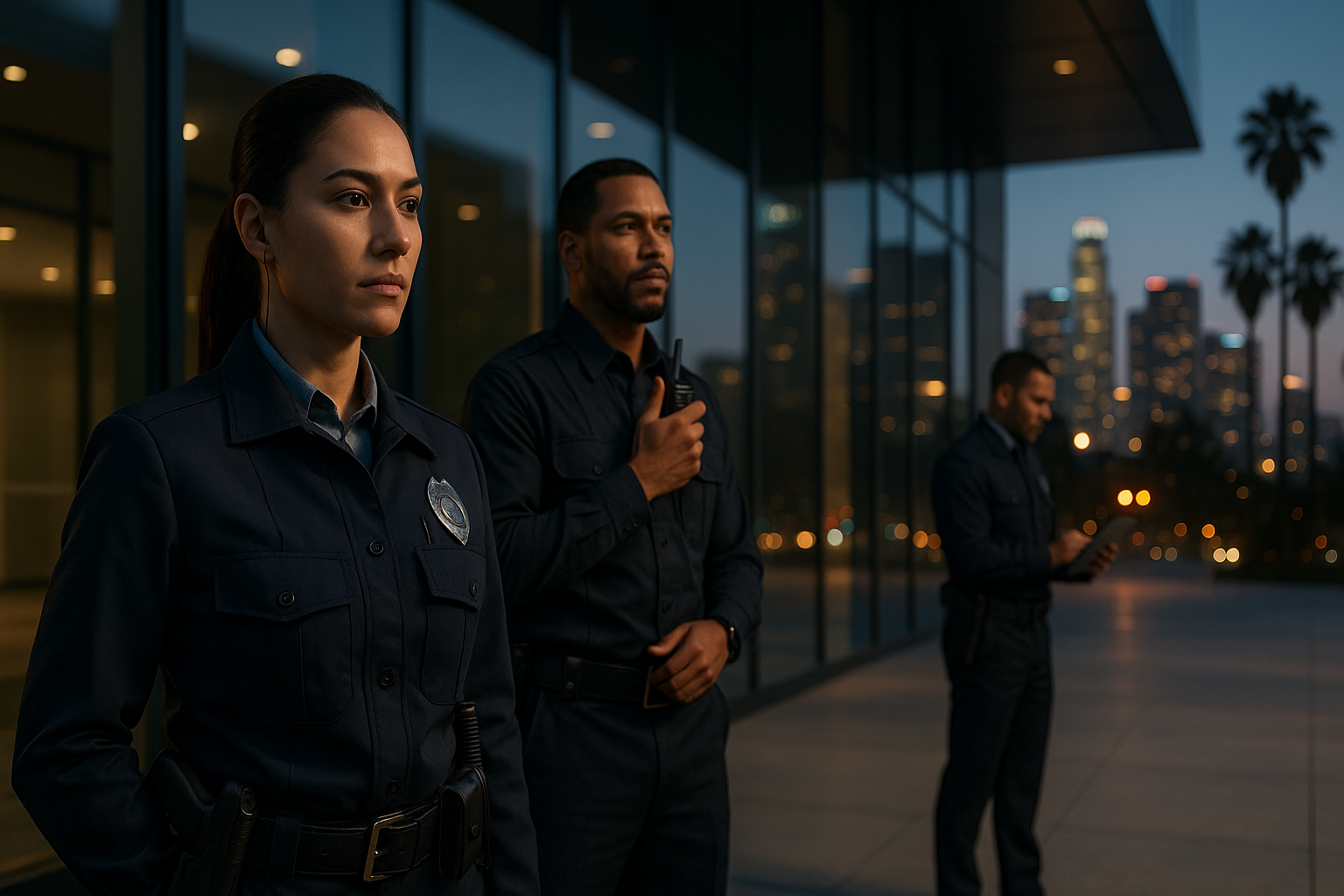
Every minute matters when safety is on the line. A single visible, trained armed security professional can stop a situation from escalating, reassure tenants or customers, and prevent losses that would cost far more than a security program. For property managers, event organizers, and business owners in Los Angeles, knowing how armed security works and how to choose the right provider is the difference between reactive frustration and proactive protection.
Armed security guards Los Angeles are a specialized resource, regulated and tested, who perform duties that go beyond unarmed patrols. This article explains when armed protection makes sense, how licensing and training work in California, what services and response procedures to expect, and practical steps to vet and hire a provider. Read on to understand the true responsibilities, limitations, and value of armed guards so you can make a confident decision for your site or event.
When armed security guards in Los Angeles are the right choice
Not every situation requires an armed guard. Many properties do fine with unarmed patrols, access control, or electronic monitoring. Armed security becomes the right choice when risk, liability, or potential consequences demand a higher deterrent and a faster, more force-capable response.
Typical scenarios where armed protection is appropriate include high-value retail locations and jewelry stores, nightclubs and venues with large crowds, banks and cash logistics, construction sites with expensive equipment, executive or celebrity protection, residential complexes in high-risk neighborhoods, and corporate facilities that store sensitive assets or intellectual property. Events that draw volatile crowds, political rallies, or celebrity appearances also benefit from armed officers who can handle an escalation until law enforcement arrives.
Choosing armed security is not a decision based on fear. It is a decision based on risk assessment, the nature of the asset, and the consequences of an incident. When physical harm, serious theft, or coordinated criminal activity is a realistic possibility, an armed guard is a practical investment in containment and de-escalation.
Licensing, training, and legal responsibilities in California
California has specific rules for armed private security personnel, and Los Angeles has local firms that follow both state and municipal requirements. Anyone considering armed security must understand these legal foundations.
To carry a firearm on duty, a guard must hold a valid guard card issued by the Bureau of Security and Investigative Services, and an endorsement to carry a firearm. That endorsement requires completion of state-mandated firearm training, live-fire qualification, and periodic refresher training. Firms employing armed guards must also carry appropriate liability insurance and follow storage, transport, and firearm handling standards.
Beyond basic licensing, top agencies provide additional training in conflict management, CPR and first aid, report writing, evacuation protocols, and local ordinances. Many companies require background checks, drug screening, and ongoing performance evaluations. When evaluating providers, ask for documentation of guard card numbers, firearm endorsements, and recent training records. Confirm the carrier for the company’s liability policy and any bonds that protect your property.
What armed security guards do, and what they do not do
The job of an armed security guard blends deterrence, observation, and intervention under strict legal limits. Understanding the scope of their duties avoids misaligned expectations.
Guards provide visible presence to deter theft and vandalism. They control access by verifying IDs, checking credentials, and managing entries and exits. They conduct routine patrols, inspect for safety hazards, and monitor CCTV where applicable. In incidents, armed guards stabilize the scene, separate parties, perform initial investigations, preserve evidence, and coordinate with law enforcement. They also write incident reports that may be critical in insurance claims or legal proceedings.
Guards do not replace law enforcement. They cannot conduct arrests beyond citizen’s arrest authority, nor can they perform searches without consent. Use of force follows strict rules: weapons are a last resort, justified only when an imminent threat of serious bodily harm or death exists. Agencies should have clear, written use-of-force policies and require that all incidents are reported and reviewed.
Typical deployment models and shift coverage options
Los Angeles clients use armed guards in several flexible models tailored to the site and hours of risk.
For fixed-site protection, guards are posted at entrances, reception desks, or high-risk interior points. Rotating foot patrols or vehicle patrols supplement static posts to maintain visibility and reduce complacency. Mobile patrols serve multiple sites across a neighborhood, providing periodic checks and rapid mobilization when an alarm triggers.
Event security usually mixes armed and unarmed staff, with armed guards positioned at perimeter points, VIP areas, and cash-handling stations. For executive or personal protection, armed officers may travel with clients, perform advance site checks, and coordinate travel routes.
Shift coverage is critical. High-risk locations often need 24/7 protection. Night shifts require officers trained to work solo or with limited backup, and daytime shifts frequently involve more visitor interaction. Agencies should offer staggered shifts, overlapping relief periods, and rapid backup protocols so coverage never drops during shift changes.
Technology integration and how guards use tools effectively
Armed officers are more effective when paired with technology. Modern security programs blend human judgment with systems that extend reach and documentation.
CCTV systems enable guards to verify alarms and monitor blind spots without leaving key positions. Mobile patrol apps let guards log checks, capture time-stamped photos, and escalate incidents to supervisors. Body-worn cameras can record interactions, improving transparency and providing evidence after an incident.
Access control systems reduce human error by only allowing credentialed entrants, while panic buttons and duress alarms provide immediate distress signals to on-site guards and remote dispatch. Radio networks, GPS tracking of patrol vehicles, and cloud-based incident reporting all speed coordination with law enforcement and management.
When evaluating vendors, ask how they integrate hardware and software with their personnel, and whether the technology is included in contract pricing or offered as an add-on.
How to vet and hire an armed security company in Los Angeles
Hiring the right firm is as important as hiring the right guards. The wrong company can increase liability and provide a false sense of security.
Begin by requesting proof of licensing, liability insurance, and worker compensation. Verify guard card numbers and firearm endorsements through the state database if available. Ask about hiring standards, including background checks, drug testing, and the average tenure of guards, which reflects retention and experience.
Review training curricula. Beyond firearms qualification, ensure the firm trains in conflict resolution, first aid, emergency evacuation, and report writing. Ask for sample incident reports to evaluate clarity and thoroughness. Request references from clients with similar needs, and follow up with those references about reliability, responsiveness, and contract adherence.
Contract terms matter. Confirm staffing ratios, relief protocols, and how the firm manages overtime and substitute staffing. Define performance metrics, such as response times to alarms, daily patrol completion, and timeliness of incident reports. Include a clause for periodic security reviews so the program can adapt to changing threats.
Cost factors and how to budget for armed protection
The cost of armed security varies based on risk, location, required skill level, and hours of coverage. Expect higher rates for officers with specialized training, for night shifts, and for rapid response or mobile units that require vehicles.
Other contributors to cost include comprehensive insurance, technology integration, uniform and equipment costs, and the administrative overhead of scheduling and supervision. Hourly rates in Los Angeles will reflect prevailing wages and benefits that reputable firms provide to retain qualified staff.
To budget effectively, calculate total hours per week, account for holidays and overtime premiums, and include a contingency for special events or potential scaling. Compare proposals not just on price but on what is included, such as supervisory oversight, incident reporting, background check fees, and equipment like radios or body cameras.
Real-world examples and scenarios
Example 1: Boutique jewelry store. The owner installed visible armed guards after two smash-and-grab attempts. Guards performed interior patrols during peak hours, monitored CCTV, and coordinated with a nearby armored carrier for cash transfers. The presence reduced incidents, and insurance premiums decreased after six months of consistent reporting.
Example 2: Construction site theft. A project manager dealing with nightly equipment theft hired mobile armed patrols that checked multiple sites along a corridor. Patrols responded within minutes to alarm activations, detained suspects until police arrived, and maintained detailed logs. Losses dropped significantly, and project timelines improved.
Example 3: High-profile event. An event coordinator combined unarmed venue staff for crowd control with stationed armed guards at VIP entry points. Guards managed ingress checks, inspected credential badges, and provided a rapid response team near the stage. The layered approach allowed crowd-friendly interactions while maintaining an elevated security posture.
These scenarios show that armed guards act as a central layer within a broader security plan, not a standalone solution.
Incident management, reporting, and coordination with law enforcement
One of the most valuable services an armed guard provides is professional incident management. When an incident occurs, a trained officer secures the scene, prioritizes medical needs, preserves evidence, and facilitates efficient handoff to police and emergency services.
Expect detailed incident reports that include time-stamped actions, witness accounts, photographs, and any physical evidence collected. These reports should be delivered promptly and stored for future claims or investigations. A strong agency will also conduct internal reviews after serious incidents, identifying procedural gaps and proposing corrective measures.
Coordination with local law enforcement matters. Reputable firms maintain communication lines with local patrol stations and understand response times in different neighborhoods. They will not attempt to supersede police authority, and they will cooperate fully during investigations.
Common misconceptions and realistic expectations
A common misconception is that armed guards will eliminate all risk. They reduce risk, but no security measure is perfect. Guards deter opportunistic crime, intervene within legal boundaries, and provide documented responses. Expect fewer incidents and faster resolution, not absolute prevention.
Another misconception is that more visible force invites confrontation. Professional training focuses on de-escalation and controlled presence. Properly briefed guards know how to be assertive without provoking unnecessary conflict, and professionalism often defuses tension before force becomes relevant.
Finally, people sometimes assume that cheap equals sufficient. Low-cost providers may cut corners on training, vetting, or supervision. Investing in competent, well-supported personnel pays off in fewer incidents, better relationships with the community, and lower long-term costs.
Conclusion
Armed security guards Los Angeles provide a measurable layer of protection for properties and people where risk demands it. Their value lies in trained judgment, legal compliance, deterrence, and the ability to stabilize dangerous situations until law enforcement takes over. Choosing the right provider requires reviewing licenses and training, understanding deployment models, integrating technology, and setting clear contractual expectations. With a thoughtful approach, armed protection becomes a practical, accountable part of a broader safety plan that protects assets, people, and reputation.